

































Roof Fans 101: Natural Exhaust for Warehouses and Sheds
Walk into a large warehouse or industrial shed on a hot Australian summer’s day and you’ll often notice something straight away: the heat. Even when the outside temperature is manageable, conditions inside a warehouse can become surprisingly uncomfortable. Metal roofing absorbs heat from the sun, machinery generates additional warmth, and with limited ventilation, hot air can build up throughout the day. The challenge is that many warehouses simply aren’t designed to move this trapped air effectively. That’s where roof exhaust fans can make a significant difference. By helping remove hot, stale air from inside a building, roof ventilation systems can improve airflow, reduce heat build-up and contribute to a more comfortable working environment. But how do roof exhaust fans actually work, and what should businesses consider before installing them?
Why Does Heat Build Up Inside Warehouses?
To understand the value of roof ventilation, it helps to understand what’s happening inside a typical industrial building. Warm air naturally rises. In warehouses with high ceilings, this means heat can accumulate towards the roof, creating a layer of warmer air above the working area. This effect is known as thermal stratification. In buildings with metal roofing, solar heat gain can make the situation worse. During warmer months, the roof can become a major source of heat entering the building, while machinery, lighting and other equipment may contribute additional warmth. Without an effective way for hot air to escape, temperatures can continue to rise throughout the day. The result? Uncomfortable working conditions, increased demand on cooling equipment and areas where air feels stagnant or stuffy. For warehouses, factories and industrial sheds, managing this heat build-up is an important part of maintaining a productive working environment.
How Do Roof Exhaust Fans Work?
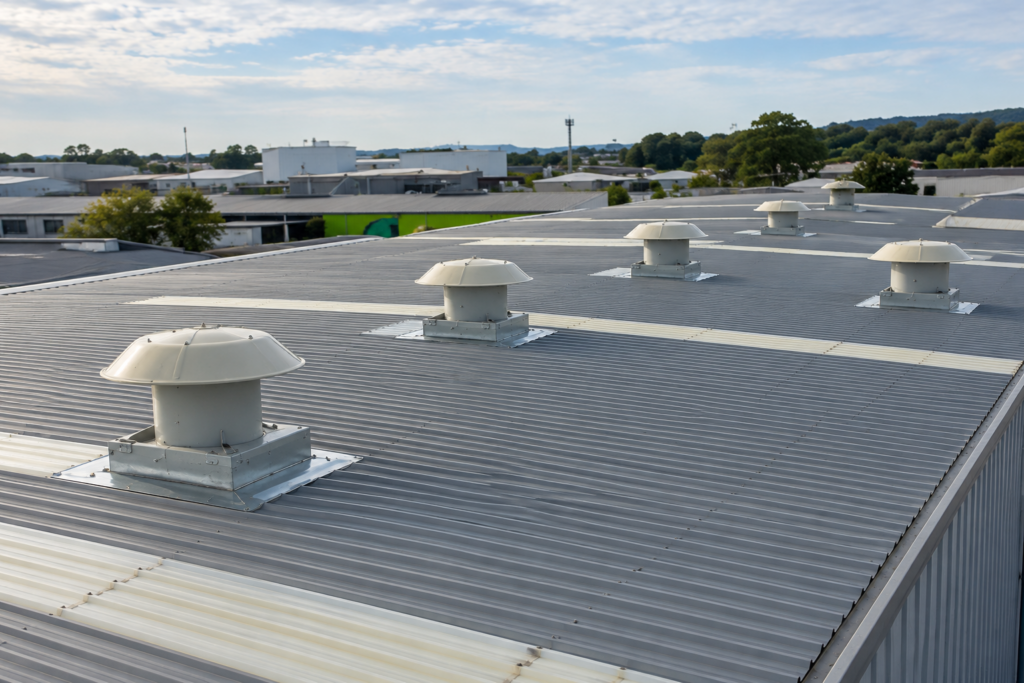
The basic principle behind roof exhaust ventilation is surprisingly simple. Hot air rises, and roof exhaust fans help remove it. Installed at roof level, these fans extract warm or stale air from inside the building and discharge it outdoors. As air is removed, replacement air must enter the building through suitable openings, such as wall vents, louvres, doors or dedicated supply-air systems. This creates a continuous exchange of air, helping reduce the accumulation of heat and stale air inside the building. There are two common approaches to roof ventilation:
Natural Roof Ventilation
Natural ventilation relies on wind pressure and the natural tendency of warm air to rise. Roof vents, ridge ventilators and other passive systems allow warm air to escape without using a powered fan. While this can be an effective solution in suitable buildings, performance depends on weather conditions, available openings and the temperature difference between indoors and outdoors.
Mechanical Roof Extraction
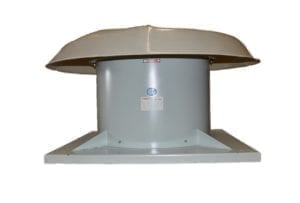
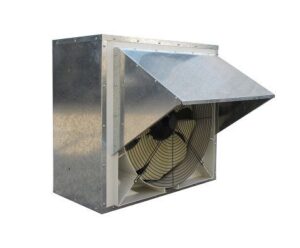
Mechanical roof extraction uses powered fans to actively remove air from the building. Unlike passive roof vents, mechanical systems provide a more controllable extraction rate, making them useful where consistent ventilation is required. Fanmaster’s industrial roof fan range is designed for mechanical extraction applications, helping businesses manage airflow in larger commercial and industrial spaces.
What Are the Benefits of Roof Exhaust Fans?
Roof ventilation can deliver several practical benefits when correctly selected and installed.
- Helps remove trapped heat: one of the biggest advantages of roof exhaust fans is their ability to remove warm air that accumulates near the ceiling. By extracting this air, roof fans can help reduce heat build-up and improve conditions throughout the building. This can be particularly valuable in warehouses with high ceilings, large roof areas and significant solar heat gain. It’s important to remember that ventilation does not refrigerate the air. On extremely hot days, additional cooling may still be required.
- Improves air exchange: warehouses can contain areas where air movement is limited, particularly in large buildings with extensive racking or internal partitions. Roof extraction encourages air exchange by removing indoor air and allowing replacement air to enter. When correctly designed, this can help reduce stagnant air and improve overall ventilation.
- Supports workplace comfort: working in a hot, stuffy warehouse can be uncomfortable, particularly for employees performing physically demanding tasks. Effective ventilation can help manage indoor conditions and support a more comfortable working environment. While ventilation alone may not solve every temperature problem, it can form an important part of a broader workplace heat management strategy.
- Can reduce reliance on mechanical cooling: in suitable conditions, removing accumulated heat through ventilation may reduce the amount of additional cooling required. This can be particularly useful in warehouses where fully air-conditioning the entire building would be impractical or expensive. However, the energy savings depend on the building design, outdoor conditions and how ventilation interacts with any existing cooling system.
- Suitable for large industrial spaces: roof exhaust fans are commonly considered for applications such as warehouses and distribution centres, manufacturing facilities, industrial sheds and workshops, storage buildings, agricultural sheds and commercial and industrial facilities with high ceilings. The type and size of fan required will depend on the building’s dimensions, heat loads, available replacement air and ventilation objectives.
Roof Exhaust Fans vs Wall Exhaust Fans: What’s the Difference?
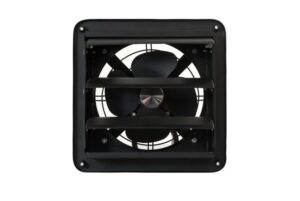
Both roof exhaust fans and wall exhaust fans remove air from a building, but their positioning can make them better suited to different applications. Roof exhaust fans are installed at roof level, making them useful for removing heat that accumulates near the ceiling. Wall exhaust fans are installed through external walls and can be positioned to extract air from particular areas or create cross-ventilation. In some facilities, a combination of roof and wall extraction may provide a more effective solution than relying on one type of fan. The key is understanding where the air needs to move and how replacement air will enter the building.
What Size Roof Exhaust Fan Does a Warehouse Need?
This is one of the most common questions businesses ask when considering industrial ventilation. Unfortunately, there isn’t a universal answer. The correct roof fan size depends on several factors, including the building’s volume, ceiling height, heat sources and intended ventilation performance. One method used to assess general ventilation requirements is air changes per hour (ACH). ACH describes how many times the volume of air inside a space is theoretically replaced within one hour. For example, consider a warehouse measuring: Length: 40 metres/Width: 25 metres/Height: 8 metres. The total internal volume is 8,000 cubic metres. If the design calls for six air changes per hour, the required theoretical airflow would be: 8,000 m³ × 6 ACH = 48,000 m³/h. This provides a starting point for considering fan capacity. However, six ACH is an illustrative figure, not a recommended rate for every warehouse. Actual requirements depend on the application, applicable standards, heat loads, contaminants and ventilation design. Fan performance also needs to account for resistance from louvres, ducting and other system components. A properly assessed ventilation system is always preferable to simply selecting fans based on floor area.
Why Replacement Air Is Just as Important as Extraction
One of the most overlooked aspects of warehouse ventilation is replacement air. It’s easy to focus on how much air a roof fan can extract, but every cubic metre of air removed needs to be replaced. If there aren’t enough suitable openings for fresh air to enter, the extraction system may not operate as intended. This can reduce fan performance and create unwanted pressure differences inside the building. For effective roof ventilation, it’s important to consider both sides of the equation: Air out + replacement air in = effective air exchange. The positioning of intake openings also matters, particularly where the objective is to move cooler outside air through occupied areas before exhausting warmer air at roof level.
Fanmaster Roof Ventilation Solutions
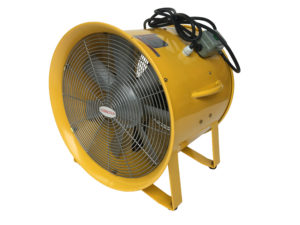
At Fanmaster, we understand that every warehouse and industrial building has different ventilation requirements. That’s why our range extends beyond traditional industrial fans to include commercial and industrial ventilation and extraction equipment. Our roof ventilation offering includes hooded roof fans and centrifugal roof extraction solutions designed for applications where air needs to be discharged through the roof. These systems can form part of a broader ventilation strategy alongside wall exhaust fans, axial flow fans, industrial air circulators and other air movement equipment. Whether you’re planning ventilation for a new industrial facility or looking to improve airflow in an existing warehouse, choosing the right equipment starts with understanding the building and its operating conditions. Explore our Hooded Roof Fans range to learn more about the roof ventilation solutions available from Fanmaster.
Good ventilation starts with good planning. Roof exhaust fans may not be the most visible equipment in a warehouse, but they can play an important role in how comfortable and functional the building feels. By helping remove trapped heat and stale air, a correctly designed roof ventilation system can improve air exchange and support better indoor working conditions. The important thing is to look beyond the fan itself. Building layout, airflow pathways, replacement air, heat sources and ventilation requirements all need to work together. At Fanmaster, we’re more than fans. We supply a comprehensive range of heating, cooling, ventilation and extraction solutions for Australian commercial and industrial workplaces.
Need help choosing the right ventilation solution for your warehouse or industrial shed? Contact the Fanmaster team on 1300 900 345 or visit www.fanmaster.com.au to explore our range and discuss your requirements.